
Night may be the best time of day to explore downtown Bangor.
Night may be the best time of day to explore downtown Bangor. |
The revelation wasn't surprising. Activity in downtown Bangor winds down by 7 p.m. Except for a few restaurants, by that time shop owners have long since turned their "open" sign to "closed," cashed out their register and taken their apron off. Even the Bangor Mall closes at 9 p.m. on weekends.
There are a handful of downtown pubs and restaurants that stay open past 10 p.m. on weekends, but they are the exception.
Still, just because the stores and restaurants have closed doesn't mean there isn't anything to do. You could watch a midnight movie at Hoyts Cinemas near the Mall, but with the quality of today's films, you would be better off saving your money for other, more meaningful things.
Money cannot buy a quiet stroll through downtown Bangor on a midsummer night. Almost any summer night is ripe for a stroll down the city's brick-lined sidewalks and through the Norumbega and Kenduskeag parkways, which feature monuments to the city's place in American history.
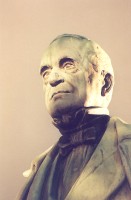 Hannibal Hamlin watches over the Kenduskeag Stream. |
At night, there's no rush to get to the bank before it closes, no noisy stop-and-go traffic around the Hammond Street-State Street-Harlow Street-Central Street roundabout. The traffic signals don't turn yellow then red before you can drive 10 feet. You don't have to drive around the block a few times in search of a parking space if you don't want to use the Pickering Square garage or the Abbott Square lot.
Downtown Bangor takes on a different persona when the sun goes down and the moon comes up. Everything looks and feels different. Time seems to stand still. It doesn't matter whether the sky is cloudy or clear, or whether a thick fog has crept up the Penobscot River and seeped between buildings and down streets, consuming everything in its path. In fact, a foggy summer late night downtown can be better than a sunny day with nary a cloud in the sky.
To fully appreciate downtown Bangor at night, you must walk, or else you will miss becoming a part of the atmosphere.
A late-night walk through downtown Bangor will likely reveal things you have never seen before or never given much thought to. Who has time during the day to stop at the memorials, monuments and statues that are testaments of the Queen City's history? Or ponder the history of the brick-and-granite buildings? At night, you have all the time in the world to do these things.
The stone-and-granite buildings that make up the downtown landscape owe their existence to the Great Fire of 1911. After a devastating fire swept through the business district on April 30, 1911, decimating the area and cutting the city off from the rest of the world for almost a week, Bangor residents cleaned up the ashes and debris and replaced the destroyed wooden buildings with more resilient materials. The fire was so large and burned so bright that people up to 30 miles around saw the fire's glow in the night sky.
 Lady Victory statue, Norumbega Parkway. |
At Norumbega Parkway, between Franklin and Central streets, the Lady Victory statue stands tall, holding two lighted torches and wearing a laurel wreath in honor of Bangor residents who have died in war. The old Norumbega Hall stood on this small island in the Kenduskeag before the Great Fire destroyed it. The city bought the less than 1/2-acre lot in 1912 to use as a fire break. In 1933, the city turned the lot into a park using money bequeathed to the city by Luther H. Peirce.
A couple of hundred yards away, at Kenduskeag Parkway, between Central and State streets, the imposing and determined yet gentle Hannibal Hamlin statue looks over the Kenduskeag Stream. When the light from a nearby lamp shines just right through nearby trees, you might wonder whether the eyes of the statesman have come alive.
Two cannons are in front of Hamlin, one on each side of the walkway. The cannon to Hamlin's left was recovered from an American ship lost in battle in the Penobscot River during the Revolutionary War in 1779, near where the Joshua Chamberlain Bridge is now. The British routed the Americans, handing the young nation its worst Naval defeat. That loss now ranks second to Japan's victory at Pearl Harbor.
The cannon to Hamlin's right, from a Spanish galleon, was recovered from Havana Harbor in Cuba during the Spanish-American War, which the mysterious sinking of the Battleship Maine sparked.
The well-lighted parkways, with their clean stone and wooden benches, are perfect places for hanging out with a friend or loved one or taking a break during your late-night stroll.
On nearby Harlow Street next to the Bangor Public Library, the River Drivers monument takes on a different persona from a hot and bright sunny summer day. The three men working together to pry loose the key log in a jam appear more relaxed at night than they are during the day.
 The old Windsor Hotel, corner of Harlow and Franklin streets. |
If you step back far enough toward the library, the old-fashioned-style street lights along the front of the former Windsor Hotel -- now home to a restaurant, religious bookstore, insurance agency and apartments -- give the slender three-story building a modern yet historic appearance. The Windsor was one of Bangor's best-known hotels during the city's lumber days. The Great Fire destroyed the original structure, but the owner rebuilt. In fact, owner Frank Wellington Durgin reportedly hunted down a guest who had paid for his stay in advance, so he could give the guest a refund.
The new Windsor had 100 rooms, hardwood floors, rugs, electricity, private baths and hot and cold water.
"All the beds have silk floss mattresses and the best springs money can buy," one ad said.
Basic rooms with hot and cold water were $1 each per person per night while rooms with a private bath and toilet were $1.50 per night.
The Windsor burned again on April 14, 1950, but the Bangor Fire Department saved the first, second and third floors.
With its steel and aluminum pretzel-like sculpture -- named Continuity of Community and presented to the city in 1969 -- the lighted fountain at West Market Square exudes a sense of warmth no matter what the season during the night in downtown Bangor. The lights that highlight the nearby Phenix Inn's facade give off a sense of Bangor's earlier years while the soft pattering of the modern fountain provides a soothing backdrop.
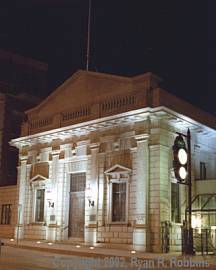 Bangor Savings Bank, State Street. |
Around the corner and across the State Street bridge, soft-white floodlights in the sidewalk illuminate the Bangor Savings Bank's facade until shortly before midnight, but the old-fashioned-style clock and thermometer remain lit throughout the night. The large, six-story brick-and-granite building across the street -- 6 State St. -- looms in the dark. The building was the setting for large land deals during Bangor's prosperous lumbering days.
Exchange Street has seen better days, but its buildings are being renovated slowly. From 1907 until the 1960s, Union Station and its high clock tower loomed over the street from the bank of the Penobscot. Bangor's Urban Renewal movement demolished the train station in favor of a small strip mall. Nevertheless, a walk down Exchange Street toward the river is still a pleasant experience as you look to the right at the dozens of overlapping buildings in the skyline. The former Unitarian Church, at the corner of Union and Main streets, towers over buildings on the west side of the Kenduskeag Stream. Built in 1827, it is the oldest church building in the city, although it is no longer a church.
Columbia Street Baptist Church and its twin bell towers bask in the soft yellow light to the right of, and not far from, the Unitarian Church.
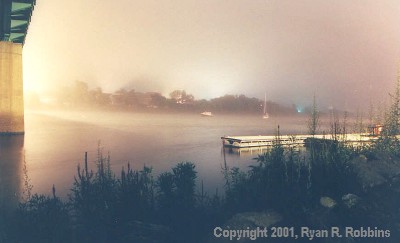 A light mist rises from the Penobscot at the Bangor waterfront. |
Continue walking along Exchange Street until you reach Washington Street, cross the Kenduskeag and pick up the path that leads along the mouth of the Kenduskeag to the Bangor waterfront. On a good night, when the tide is returning, a slight mist will rise from the Penobscot below the Chamberlain Bridge. The river lies seemingly still on such nights, and the soft mist rising from the water provides an atmosphere appropriate for the watery graves of more than a dozen American ships destroyed in the Revolutionary War during the young nation's worst defeat to the British, on Aug. 15, 1779.
The Chamberlain Bridge provides the best pedestrian view of the Queen City at night. Steeples from the former Unitarian Church, Hammond Street Church, St. John's Episcopal Church, All Souls Congregational Church and St. John's Catholic are all visible. The lights along Washington Street reflect off the Penobscot in delicate hues of yellow, blue and white. Below the bridge to the west, boats moored off-shore rock gently in the calm, dark water. You can only imagine what the scene was like before the Europeans arrived: a full moon reflecting off the black water some 30 miles upriver from the ocean, pine trees that would prove almost as valuable as gold standing tall at what is now downtown Bangor.
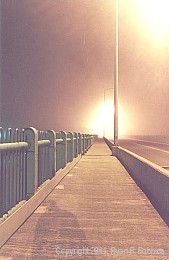 Fog swallows the Chamberlain Bridge. |
Perhaps a humid and foggy late-summer evening might evoke a more sinister mood much like Stephen King's short story "The Mist," in which a mysterious fog swept through a small town and swallowed anyone who dared tempt it. Indeed, when the conditions are just right, the Chamberlain Bridge seemingly curves over the Penobscot into nothingness. You can see neither the east bank of Brewer or the west bank of Bangor on such a night -- not even the the eight-story Fleet Building that dominates the skyline or the brightly lit Pickering Square garage.
After visiting the Chamberlain Bridge and the waterfront, retrace your steps and cross Washington Street while remaining on the west side of the Kenduskeag. The Pickering Square parking garage looms over the west bank of the Kenduskeag, its lights casting a dull presence along the walkway that hugs the stream and over Pickering Square. In the city's early days, Pickering Square was home to shacks where butchers and other merchants practiced their trades while horses carried customers and passers-by.
Main Street is often quiet downtown at this time of day. Lighted storefront windows showcase merchandise varying from jewelry to clothes to musical instruments. Not exactly what early European explorers had in mind when they claimed to have found Norumbega, the lost city of gold. Still, downtown Bangor remains a "star on the edge of night, still hewing at the forests of which it is built," as Henry David Thoreau described the Queen City so eloquently in his collection of essays titled "The Maine Woods."