
April 22, 2004
Kenduskeag Stream Canoe Race draws thousands
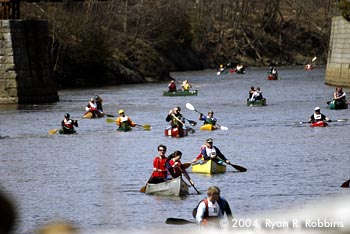 Racers make their way into downtown Bangor Saturday. See more photos of this year's race here. |
Thousands more turned out along the 16 1/2-mile stretch of the stream from Kenduskeag to downtown Bangor to watch.
Kenny Cushman and Fred Ludwig beat all racers with their two-man kayak, finishing the race in 1:58:35. Trevor Maclean, who entered the race as the two-time defending champion, finished 25 seconds later.
David Smallwood and Jeff Sands finished third, with a time of 2:07:15.
The fastest solo canoeist was Barry Dana, who finished in 2:25:14. The top woman kayaker was Paula Lunt (2:20:52).
The weather for the race was nearly perfect for the third straight year, with a mostly sunny sky and a high temperature that reached 60 degrees by 1 p.m.
Crews cleaning up Masonic Hall rubble
 Only the first-floor facade of the Masonic Hall building remains. |
An excavator has been pushing through the rubble, picking up debris and dropping it into dump trucks. Workers recently recovered two large safes that were still intact. One of the safes belonged to the Yankee Shoe Repair shop, which was on the building’s ground floor.
The Masonic Learning Center re-opened last month in the Graham Building, at the corner of Harlow and Central streets downtown.
The Masonic Hall building caught fire on Jan. 15. Fearing the building would collapse, the city ordered the building demolished the next day. The fire continued to burn during the demolition and for several days afterward. Fire officials think the fire started in the boiler room, but they have not been able to determine what caused the fire. They hope to find clues in the rubble.
As of Tuesday night, only the first-story facade of the building remained standing, with most of the debris gone.
Slot machines at Bass Park in limbo
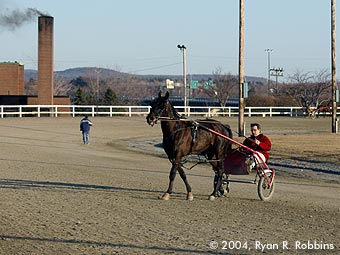 Extensive renovations to Bass Park are on hold because Penn National, Bangor Raceway's operator, says slots legislation would make investment too risky. |
Meanwhile, the Penobscot and Passamaquoddy American Indian tribes say they are ready to step in if Bangor Historic Track’s new owner, Penn National, backs out.
Penn National recently bought Bangor Historic Track, the company that manages harness racing at the city owned Bass Park, from Las Vegas developer Shawn Scott. Scott and the company he had created to manage the track, Capital Seven, were in the midst of licensing hearings before the Maine Harness Racing Commission in December when Scott agreed to sell to Penn National. The sale agreement came after a nasty battle between the two gaming companies over operations of Scarborough Downs in Scarborough.
In November, voters approved a referendum to legalize slot machines at Maine’s two full-time harness racing tracks, Scarborough Downs and Bangor Raceway, pending approval from voters in those cities. Scarborough residents voted against installing the machines in their city. Bangor residents voted for slot machines last June.
Critics of the voter-approved legislation said the new law wouldn’t regulate slot machines adequately. Gov. John Baldacci, a Bangor native, opposed the referendum. He later had new legislation introduced that would place tight restrictions on the number of slot machines allowed and revenue sharing. The voter-approved bill called for slot machine operators to give less than 40 percent of revenue from the machines to the state. Baldacci’s legislation would require operators to give the state 40 percent of slot revenues before payouts to winners. Penn National says the proposal would make it virtually impossible for the company to make the Bangor racino project worthwhile.
Last fall Scott renovated the interior of the racetrack’s grandstand so it could accommodate slots, which would operate throughout the year. The renovation cost more than $500,000. Scott had planned to raze the grandstand after the end of this coming racing season so he could build a larger, enclosed grandstand with an adjoining slot machine parlor.
While Baldacci’s legislation rests with the Legislature’s appropriations committee, members of the Penobscot and Passamaquoddy tribes are waiting to replace Penn National if the gaming company backs out. The tribes tried unsuccessfully to block the racing commission from giving Penn a conditional racing license. They argued that when Scott abandoned his bid for a permanent license the commission should have opened licensing to anyone instead of transferring the application to Penn.
The tribes sued the commission in Penobscot County Superior Court, but Justice Andrew Mead ruled for the racing commission.
The two tribes lost a statewide vote in November that would have allowed them to open a casino.
Bangor Raceway’s season is set to begin May 21. The track will offer 30 sessions. Under a new agreement with the city of Bangor, Penn has through November 2005 to install slot machines.
American Folk Festival to debut in 2005
The National Folk Festival may wrap up its three-year stint in Bangor in August, but the music and dance will continue next year as part of the new American Folk Festival.
Local organizers of the National Folk Festival announced the new festival on March 26.
Bangor is the smallest city to be host of the National festival. However, the festival drew about 40,000 people to the city in 2002 and about 70,000 in 2003 – some of the largest crowds in the festival’s 65-year history.
The National festival spends three years in each host city before moving on. In most cases host cities use the festival to launch their own festival when the National moves on.
Just like with the National festival, the American Folk Festival will be free and will be held along the Penobscot River and Kenduskeag Stream waterfronts downtown. The National Council for the Traditional Arts, the Washington, D.C.-based organization that runs the National festival, will help produce the local festival. The festival will cost almost $1 million to produce and take place in late August.
Class A basketball tournaments might leave Bangor
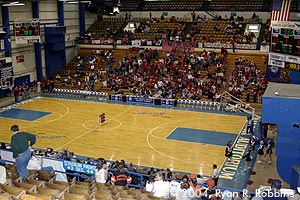 The loss of teams in the Greater Bangor area and a drop in attendance at this year's boys and girls basketball tournaments have prompted Class A schools south of Augusta to ask the MPA to move the tournaments from Bangor. |
Members of the Kennebec Valley Athletic Conference, which comprises schools in the Greater Augusta area, have asked the MPA to move the tournaments for financial reasons. In recent years, Eastern Maine Class A has lost Caribou and Presque Isle high schools and gained Brunswick, Edward Little (Auburn), Mount Ararat (Topsham) and Lewiston. The only Class A schools north of Augusta are Waterville, Nokomis (Newport), Hampden, Brewer, Bangor, John Bapst and Old Town. However, Waterville might fall to Class B after the MPA sets new enrollment cutoffs for the four classes in athletics. John Bapst will fall to Class B next season, and Hampden might move to Class B in a few years.
Currently Brunswick, Mount Ararat, Lewiston and Edward Little must all travel about two hours to Bangor to play in the Eastern Maine tournaments. The Western Maine tournaments are held at the Cumberland County Civic Center in Portland, less than an hour away from those schools.
The Bangor boys and girls and the Hampden girls were the only Greater Bangor teams to reach the quarterfinal round at the Auditorium this season. As a result, attendance plummeted.
The proposal to move the Class A tournaments to Augusta would have no effect on the Class B, C and D tournaments, which will continue to play in Bangor.